


Running a community can be deeply rewarding, and it can also become surprisingly messy.
What starts as a meaningful space for transformation can slowly turn into a long list of manual tasks. Welcome posts need tagging. Member follow-up slips through the cracks. Testimonials live in screenshots. Important conversations disappear in the feed. Retention becomes reactive instead of intentional.
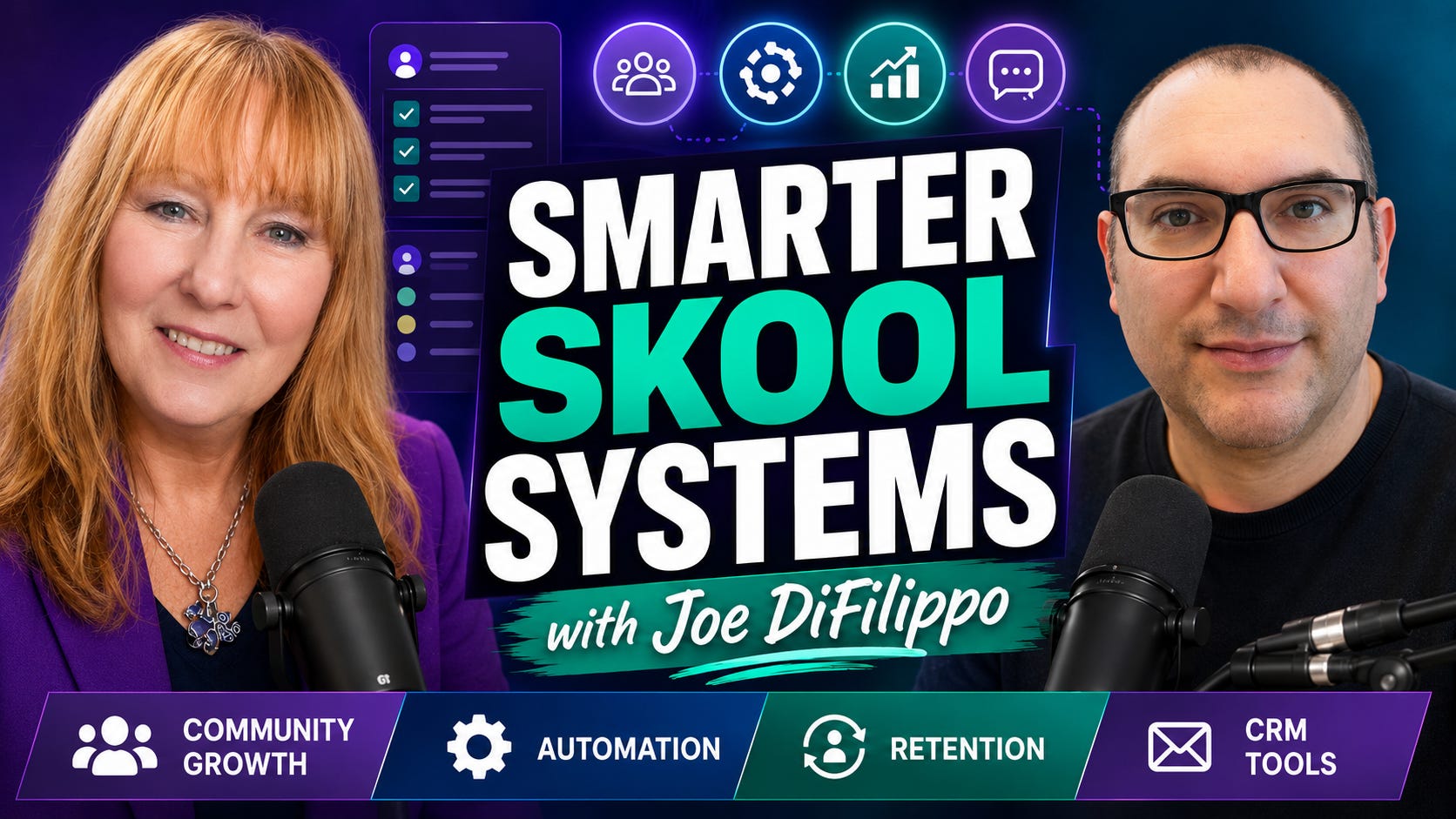
That is why this conversation with Joe DiFilippo matters.
Joe is the creator of Skooly, a tool built specifically for Skool owners and users. In this interview, he walks through a growing ecosystem of features designed to help community builders save time, improve member experience, and create better systems around engagement, organization, and retention.
A Tool Built From Real Community Problems
One of the strongest parts of this conversation is that Skooly did not begin as a generic software idea. Joe describes how he spent time inside Skool, pivoted through different models, and eventually landed on what he most wanted to do: build software that solves real problems for community owners. His focus is practical. He wants to reduce friction, automate repetitive tasks, and help owners respond quickly to what members actually need.
That orientation matters.
Too many tools ask business owners to reshape themselves around the software. This conversation points in the other direction. The goal is to create support around the way real communities work.
The Bigger Opportunity for Coaches and Community Builders
For conscious coaches, spiritual entrepreneurs, and transformational leaders, community is not just a content container. It is a trust ecosystem.
It is where people ask for help.
It is where they witness each other’s growth.
It is where belonging becomes visible.
And because of that, the systems behind a community matter more than most people think.
A strong community does not only need inspiring content. It also needs structure that helps members feel seen, helps leaders stay responsive, and makes next steps clear.
That is where many of the Skooly features Joe demonstrates become especially useful.
📌Save For Later

Tagging and Segmentation That Make Welcome Posts Easier
One simple but powerful feature covered in the episode is the ability to create member lists and tag groups of people more efficiently.
Joe shows how community owners can load members, group them by criteria like level, tier, course access, or recency, and then use those lists inside posts and comments. This makes it easier to welcome new members, reach a specific cohort, or acknowledge a segment without manually tagging one person at a time. He also explains that “new members” can be customized by date range, which makes this even more practical for recurring welcome rituals.
For coaches, this is more than convenience.
This is about creating visible belonging. A warm, well-timed welcome can help a new member feel recognized right away. And when that recognition becomes easier to deliver, consistency gets easier too.
DM Sequences That Support Relationship-Building
Another standout part of the conversation is the DM automation system.
Joe walks through Skooly’s sequence builder, showing how community owners can trigger messages when a new member joins, requests access, starts canceling, has a payment decline, levels up, upgrades, or downgrades. He also explains that messages can go either to the member or to the owner as an internal alert, depending on the use case.
This opens up important possibilities.
A welcome sequence can help new members take the first right action.
A follow-up can deepen a conversation after someone responds.
An alert can help an owner personally step in during a retention moment.
For mission-led businesses, that blend of automation and humanity is the sweet spot. The goal is not robotic communication. The goal is making sure important touchpoints do not get missed.
Testimonials and Pages That Strengthen Authority
One especially relevant section for visible coaches and experts is the way Joe describes testimonial capture and page building.
He explains that users can pull testimonials directly from posts or comments, build customizable testimonial pages, invite members to submit through a form, and even use AI prompts to help members write stronger testimonials. He also shares that Schoolie now includes a drag-and-drop page builder for landing pages and related assets, with options for videos, GIFs, CTAs, and embedded code.
This matters because authority is often trapped inside conversations.
A client says something powerful in a comment.
A member shares a breakthrough in a post.
A result is visible but not yet organized.
When you can turn those moments into social proof more easily, your visibility gets stronger. Your message gets clearer. Your next aligned client has more evidence that your work creates real change.
Insights That Help You Understand Community Health
Joe also walks through the analytics side of Skooly, including community health indicators, retention-risk tracking, post-performance insights, best-time-to-post heat maps, course progress views, and member segmentation. He describes how community owners can identify who is at higher risk, explore engagement patterns, and filter members by activity such as recent posting.
This is where growth becomes more intentional.
Instead of guessing who needs support, you can look.
Instead of posting randomly, you can learn from patterns.
Instead of treating all members the same, you can segment more wisely.
For coaches who care about client results and not just audience size, that kind of visibility can be incredibly valuable.
The Deeper Lesson Beneath the Software
What stood out most in this interview is not any single feature.
It is the philosophy underneath the tool.
Joe keeps returning to the same idea in different forms: community owners need help solving real operational problems. They need systems that support engagement, retention, focus, and follow-through. They need tools that reduce noise and make space for better service.
That is a lesson well beyond software.
As a coach or spiritual entrepreneur, growth often does not come from doing more. It comes from building cleaner pathways around what already works.
Cleaner onboarding.
Cleaner communication.
Cleaner visibility.
Cleaner retention.
Cleaner proof.
When the structure becomes stronger, the mission can move farther.
Not Quite GHL (Yet) But Close…
If you lead a community, this episode offers a useful reminder: the backend experience shapes the front-end transformation.
Members feel it when things are organized.
They feel it when they are welcomed well.
They feel it when follow-up is timely.
They feel it when the community experience is coherent.
And leaders feel it too.
Better systems create more breathing room.
More breathing room creates more presence.
More presence creates better leadership.
That is the real opportunity here.
Not just more automation.
More intention at scale.
If this conversation sparks something for you, start with one question:
Which part of your client or community journey feels more manual than it needs to be right now?
That answer may point directly to your next growth edge.
The Skooly Community on Skool (affiliate link - of course)
I Believe In You,

PS Most coaches and spiritual entrepreneurs are not stuck because they need more content.
They’re stuck because no one ever showed them how to turn their message into a movement… and their visibility into actual clients.
The ones quietly building freedom-based businesses right now are following a very different roadmap.
Inside You World Order, you’ll discover what most creators never connect:
✨ The message that attracts aligned clients
✨ The structure that turns content into conversations
✨ The visibility system that keeps working long after you hit publish
✨ And the community that helps you stop spinning your wheels alone
This is where clarity turns into momentum.
And momentum turns into income, authority, and freedom.
If you’ve been feeling like you’re doing “all the things” but still missing the bigger picture…
You probably haven’t seen the system yet. 👀
🔥 Begin your journey → You World Order Skool Community


